

Construction Insurance Project Checklist for Builders
This construction insurance project checklist helps builders review cover before a new job begins. Confirm the insured parties, project values, existing structures, construction period and contract requirements. For an overview of available services, visit ABS’s construction insurance page; this article focuses on applying those covers to a live project.
Construction insurance should follow the project, not the other way around. Buying a familiar policy and hoping it matches the contract is the wrong approach. Start with who carries each risk, identify the cover that can respond, and make sure the remaining exposure is something your business can fund.
Table of Contents
- Construction insurance project checklist: start with the work
- The Policy Types Every Builder Should Understand
- NSW Compliance Triggers You Cannot Afford to Miss
- What Drives the Price and Why a Cheap Policy Can Cost More
- The Three Coverage Gaps That Catch Builders Out
- How a Broker Actually Sets Up Cover for a New Build
- Choosing the Right Broker and a Practical Pre-Quote Checklist
Construction insurance project checklist: start with the work
A subcontractor's backhoe clips a finished slab. Rain gets into stored materials. The homeowner's solicitor sends a letter alleging defective work and demanding compensation for delays. These are hypothetical incidents, but they expose the question every builder should ask: which policy responds to which part of the loss?
Don't treat the answer as a single insurance claim. Separate damage to the works, damage to someone else's property, allegations about workmanship, professional advice and financial losses from delay. The Australian Government's construction industry insurance guidance distinguishes contract works protection for construction damage, professional indemnity for design or advice, and domestic building insurance for defined completion or rectification failures.
Start with the loss, not the policy name
For each activity, identify the property at risk, the party responsible and the potential consequences. A useful project review asks:
- Physical damage: What could damage the new works, temporary works, stored materials or existing structures?
- Third-party exposure: Could excavation, deliveries or site operations injure someone or damage neighbouring property?
- Professional responsibility: Who designs, specifies, certifies or advises?
- Commercial consequences: Who carries extra finance costs, lost income or contractual delay exposure?
Your ordinary business insurance schedule isn't proof that these project exposures are insured. Ask for the relevant policy wording, declared activities and project limits to be checked against the signed contract.
Separate defective work from resulting damage
A defective component and the damage it causes are different questions. Don't assume an insured incident means the insurer will also pay to improve the original workmanship, replace every defective component or meet every contractual demand.
Practical rule: Ask your broker to explain the likely response to a damaged slab, a defective slab and a claim for delayed handover separately.
Check the construction period, testing and commissioning, temporary works, debris removal and escalation exposure. Then record who must notify the broker when those details change. That project-specific allocation of cover is what makes construction insurance useful on a live job.
The Policy Types Every Builder Should Understand
Each policy should answer a specific question. If nobody can explain its job in plain English, don't assume it fills a gap.
Construction Policy Types and What They Cover
| Policy Type | Primary Trigger | Typical Insured |
|---|---|---|
| Contract works and erection | Insured physical loss or damage during construction or erection | Builder, contractor or principal, as scheduled |
| Builders warranty or HBC | Defined statutory circumstances involving completion or defects | Homeowner beneficiary, with cover arranged by the builder |
| Public and products liability | Covered legal liability for third-party injury or property damage | Builder or subcontractor |
| Professional indemnity | Covered claims arising from professional services, design or advice | Designer, consultant or design-and-construct contractor |
| Plant and equipment | Insured damage to, or theft of, scheduled equipment | Equipment owner or hirer |
| Owner-builder insurance | Construction and liability exposures under the selected wording | Owner-builder |
| Delay in start-up or advance loss of profit | Specified financial loss following a qualifying insured delay | Developer or project owner |
| Management liability | Covered management-related claims or events | Company, directors or officers |
Treat this as a starting vocabulary, not a promise of indemnity. The wording, insured parties, exclusions and conditions determine the response.
Match the policy to your responsibility
Contract works concerns the project's physical assets. Public liability concerns your legal responsibility to others. Before accepting a head contract, compare its requirements with the actual scope of public liability insurance coverage, particularly property being worked on and liabilities you accept under contract.
Professional indemnity deserves attention whenever you accept design, specification or advisory responsibilities. Don't dismiss it because someone else draws the plans. Give the broker the responsibilities you've accepted, not just your trade description.
Plant cover needs a separate review of owned machinery, hired-in equipment and hire agreements. An owner-builder also needs a structure suited to their role rather than a builder's policy selected by name alone.
Warranty cover isn't a completion budget
Victoria's parliamentary review recorded 14,342 domestic building insurance claims between 2019–20 and 2023–24. As at October 2024, 24% had been fully accepted and 42% partially accepted, according to the parliamentary domestic building insurance report.
The practical conclusion is straightforward: statutory homeowner protection doesn't guarantee enough money to finish a failed project without additional funding. Site security, redesign, escalation, professional fees and replacement-contractor risks need their own assessment.
Likewise, delay cover isn't general protection against running late. Ask what insured event must occur before it responds. Consider management liability separately for company and director exposures, alongside workers compensation, commercial motor, marine transit and cyber cover where the business requires them.
NSW Compliance Triggers You Cannot Afford to Miss
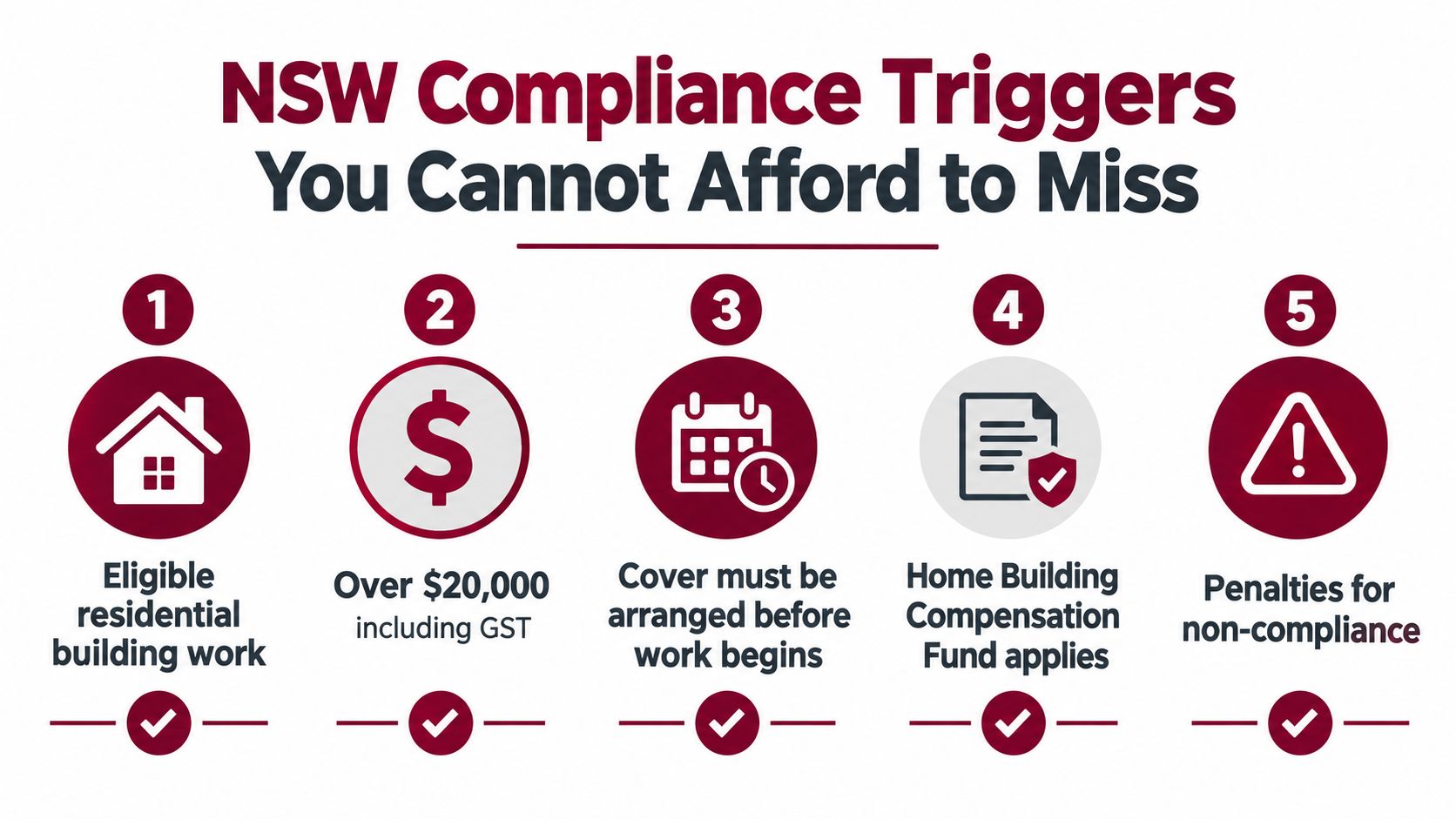
Check statutory requirements before accepting the deposit, not after organising the site. For eligible NSW residential building work exceeding $20,000 including GST, the licensed builder, spec builder or tradesperson must obtain a project-specific Home Building Compensation certificate before work starts or any money is accepted, unless an exemption applies, under icare's HBC insurance application requirements.
Match the certificate to the payment sequence
Review the signed contract, residential work classification, exemption position, certificate and proposed payment schedule together. A certificate sitting in a folder isn't enough if the project details or payment timing don't align.
NSW builders can generally seek a deposit of no more than 10% of the contract price before work starts. The NSW Government warns that payments made before HBC cover is in place, excessive deposits and some preparatory payments may not be recoverable following insolvency in its builder insolvency protection guidance.
Use the NSW Home Building Compensation Fund guide for licensed builders as a preparation aid, then confirm the position for the particular contract. Contract works and liability policies don't replace this statutory checkpoint.
Classify workers before declaring wages
Most NSW employers must maintain workers compensation cover. The obligation under section 155 of the Workers Compensation Act 1987 extends to workers and deemed workers, so a subcontractor agreement doesn't settle the classification question, as explained in SIRA's construction workers compensation guidance.
Prepare the application around:
- People performing the work: Identify employees and contractors whose engagement needs classification.
- Payroll exposure: Collect wages paid or expected and the number of workers.
- Insurance history: Provide previous policy and claims details where applicable.
- Declaration responsibilities: Assign someone to maintain estimates and actual wage records.
SIRA requires a reasonable wage estimate as soon as practicable and no later than two months after application or renewal, followed by a full and correct actual-wages declaration no later than four months after the insurance period ends, under its workers compensation guide for employers.
What Drives the Price and Why a Cheap Policy Can Cost More
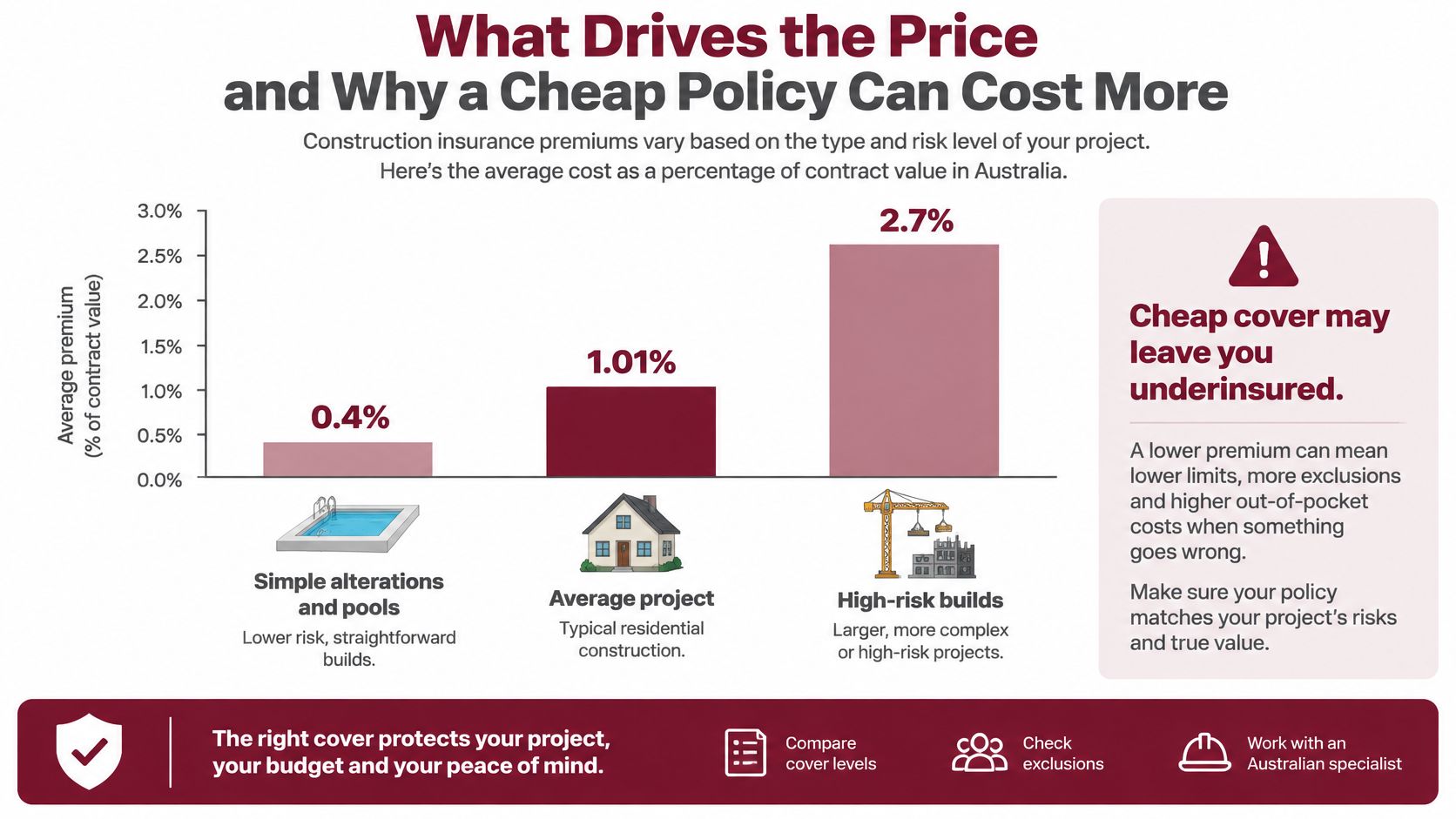
A cheap premium isn't useful if you can't afford the excess or the loss falls outside the wording. Compare total risk cost, including the premium, deductibles, uninsured exposures and the cash needed while a claim is assessed.
Historical NSW HBCF analysis put average premiums at approximately 1.01% of contract value as at June 2020, ranging from roughly 0.4% for some single-storey alterations and swimming pools to 2.7% for apartments up to three storeys. Claims costs represented approximately 70% of scheme costs, according to the HBCF scheme analysis. These are historical statutory-scheme figures, not current contract works quotations.
Severity matters as much as frequency
Historical HBCF findings included approximately 85% of claims triggered by builder insolvency and NSW major-defect claims averaging around $80,000 in 2020, as summarised in icare's HBCF premium filing discussion. That helps explain why project classification, financial strength and rectification exposure matter, rather than just whether a builder has claimed before.
Insurance availability also deserves an early conversation. Infrastructure Australia recorded participants' informal estimate of a 50% reduction in construction-insurance capacity, alongside concerns about cost, in its national infrastructure risk study. Treat that as historical market evidence, not a current quote forecast.
Test the saving against your cash position
Ask the broker to compare competing terms using the same project assumptions:
- Excess affordability: Could the business fund the deductible immediately without missing wages or supplier payments?
- Weather wording: What restrictions apply to flood, storm, water ingress and incomplete buildings?
- Restricted benefits: Which sublimits affect hired plant, professional fees, debris removal or delay-related extensions?
- Site conditions: Can the team comply with security, storage and inspection requirements?
A premium saving isn't a saving if it leaves you carrying a loss your business can't finance.
Give underwriters credible drainage plans, material-storage arrangements, temporary-works controls and documented inspections. My recommendation is to improve the exposure before just asking for a higher limit. Then select the policy your business can afford both to buy and to claim on.
The Three Coverage Gaps That Catch Builders Out
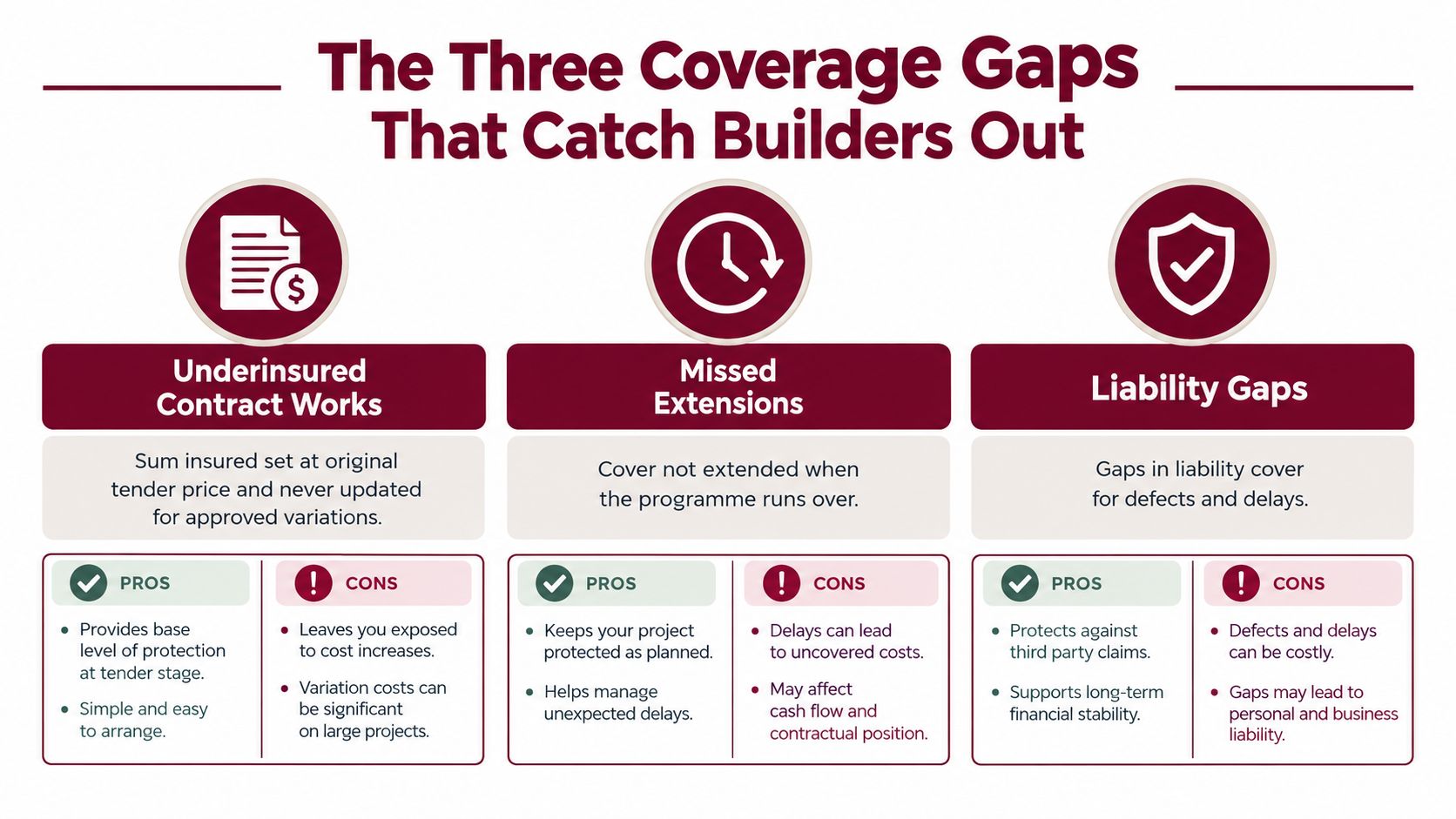
The gaps worth fixing first are those hidden between the contract, the policy schedule and what happens on site. At ABS Insurance Brokers, we focus on the following exposures when reviewing a build.
Underinsured contract works
Don't leave the sum insured at the tender figure once the scope changes. Review approved variations, escalation, demolition, professional fees, materials and any responsibility for existing structures against the policy's valuation basis.
Put the insurance review beside the variation approval process. When the project manager approves additional work, someone should check whether the declared value and policy limits need amending. An updated spreadsheet isn't an updated insurance policy.
Programme changes deserve the same discipline. Before accepting an extension of time, confirm whether the insured construction period needs extending and whether the insurer requires revised terms.
Liability and subcontractor assumptions
A head contractor shouldn't assume its liability policy protects every subcontractor, every contractual indemnity or all property being worked on. Obtain current subcontractor insurance evidence, but don't stop at collecting certificates.
Use the evidence to check:
- Entity and activity: Does the insured business match the contractor engaged and the work performed?
- Policy period: Will cover remain current during the subcontractor's involvement?
- Responsibility allocation: Who carries the relevant liability under the subcontract and head contract?
- Unresolved restrictions: Is an endorsement, separate policy or legal contract review needed?
Ask the broker to identify assumptions that remain unconfirmed. Silence on the schedule isn't confirmation of cover.
Plant, tools and materials away from site
Map the physical journey from supplier to storage, transport, installation and removal. Include hired-in plant, mobile equipment, tools kept in vehicles and materials stored away from the declared site.
For each stage, record who owns the item, who carries the risk and which policy is intended to respond. Check hire agreements against the equipment cover rather than assuming the hire company's arrangements protect you.
Site action: Give the broker the storage addresses, transport arrangements and equipment hire terms before the assets move.
For NSW residential projects, keep the statutory certificate gate described above separate from these operational checks. Closing a plant or liability gap doesn't satisfy the homeowner-protection requirement.
How a Broker Actually Sets Up Cover for a New Build
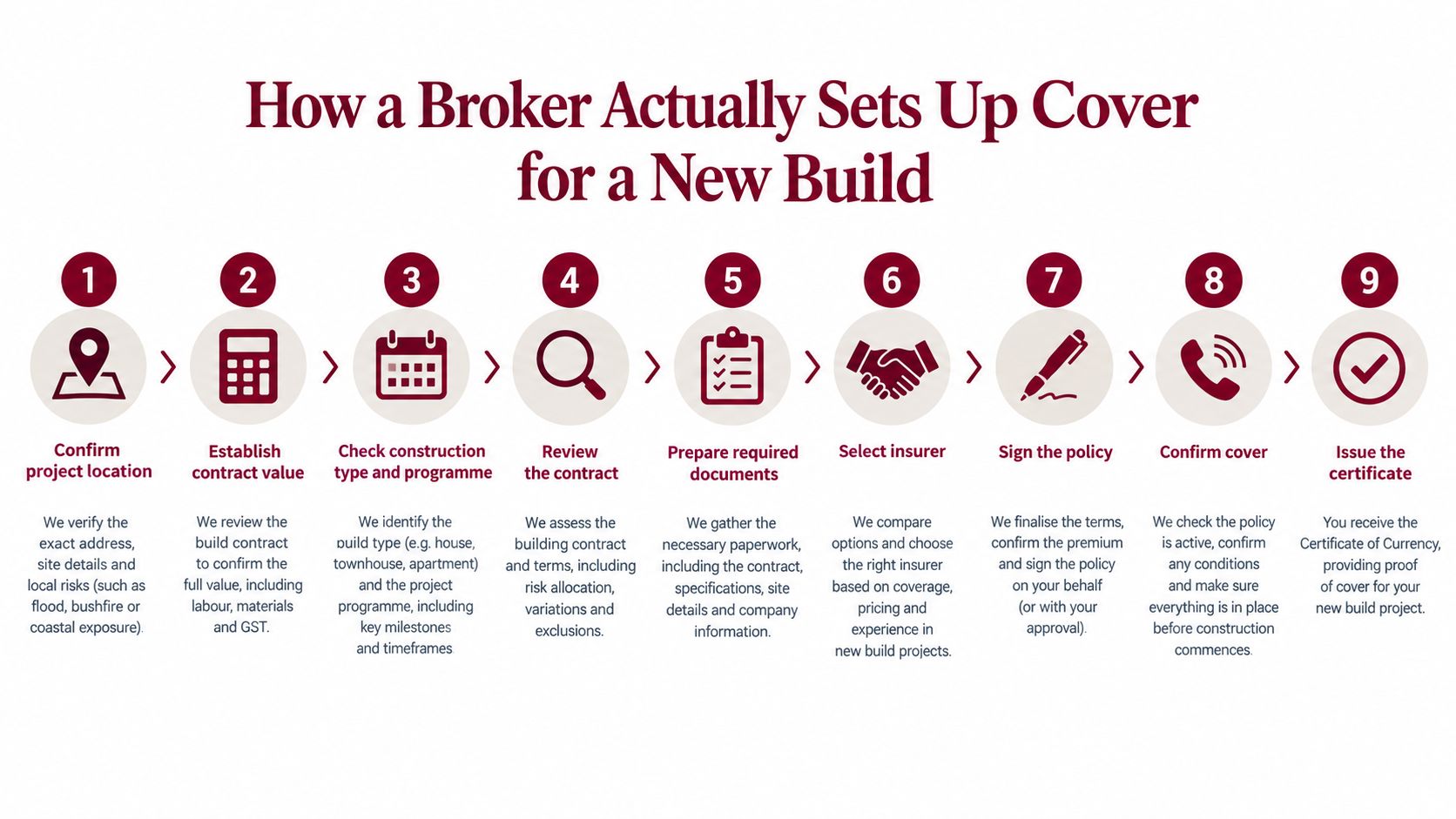
A certificate is the output of placement, not the placement process itself. At ABS Insurance Brokers, we use a structured workflow so the project, contract and underwriting submission tell the same story.
From project review to written confirmation
Understand the project. Confirm the location, contract value, construction type, programme, principal parties, builder, subcontractors and unusual site risks. Flag unfamiliar methods or activities immediately.
Review the contract. Check the insurance schedule, liability limits, contract works obligations, named parties, lender requirements and responsibility for existing structures.
Identify the cover mix. Assess contract works, public and products liability, owned and hired plant, commercial motor, professional indemnity, workers compensation, marine transit and cyber exposures.
Check statutory requirements. Apply the NSW HBC checkpoint where relevant, including exemptions and the proposed commencement and payment sequence.
Prepare underwriting information. Assemble scope, values, programme, claims history, construction methods, security, subcontractor arrangements and risk controls. Resolve inconsistent documents before approaching insurers.
Source suitable terms. Approach appropriate insurers and underwriting agencies for the project's risk profile, using Steadfast network access where relevant. Market access matters, but suitability still needs to be demonstrated.
Compare quotations. Examine sums insured, excesses, insured parties, existing structures, variations, materials, defects-liability provisions, exclusions and special conditions. Record material differences rather than ranking quotations by price alone.
Bind and document cover. After written client authority, arrange confirmation and provide certificates, policy documents and required endorsements. Check that the issued documents reflect the agreed placement.
Manage changes during construction. Request notification of major variations, increased values, extensions, new activities and incidents so the insurance can be reviewed before an exposure falls outside the agreed terms.
Prepare for claims before an incident
Good claims support starts with prompt insurer notification and an organised evidence file. Our role includes helping the builder provide the contract, programme, photographs, invoices, site records and mitigation evidence, while explaining the practical effect on the build.
We don't publish identifying client details or unverified claim outcomes. Any public case study should use confirmed facts, remove identifying information and distinguish the broker's assistance from the insurer's coverage decision.
Ask who will manage that work before you appoint a broker. You need a defined claims contact and a clear document process, not an unsupported promise about settlement.
Choosing the Right Broker and a Practical Pre-Quote Checklist
Choose a broker who asks difficult project questions before discussing price. Construction expertise should show up in the contract review, HBC knowledge, underwriting submission and explanation of uninsured exposures.
Ask prospective brokers how they use market access, including Steadfast where applicable, and how their AFSL-compliant processes handle advice, written authority and documentation. Examine client feedback for evidence of responsiveness and claims assistance, but ask directly who will handle your account and what happens when that person is unavailable.
Assemble a useful quote file
Send a coherent project pack rather than forwarding disconnected documents over several emails. Start with the construction insurance pre-quote information checklist and include:
- Contract documents: Signed contract, insurance schedule, scope of works, principal and lender requirements.
- Project details: Location, current value, programme, construction methods and existing-structure responsibilities.
- Site controls: Security, drainage, storage, temporary works and inspection arrangements.
- People and history: Claims records, subcontractor insurance evidence, wages, worker numbers and contractor engagement details.
- Asset movements: Plant schedules, hire agreements, transit arrangements and off-site storage locations.
Tell the broker what hasn't been finalised. An unresolved design responsibility or uncertain storage location is something to investigate, not something to omit from the application.
Measure performance beyond premium
A construction insurance programme should have a working dashboard, not just a renewal invoice. Track certificate compliance before commencement, insured values against current project exposure and subcontractor insurance compliance.
For cost and claims, monitor premium by project, turnover or contract value, renewal movement, claims frequency and severity, open-claim duration, recovery outcomes and reporting timeframes. Include deductibles, uninsured losses and recurring causes so a lower premium doesn't disguise a more expensive risk position.
For service and control, record binding time, certificate issuance, endorsement turnaround, live-project exclusions and sublimits, and completed risk-improvement actions. Assign responsibility for notifying variations, extensions and incidents.
The objective isn't the lowest premium. It's a contract-compliant project, insurance that stays aligned with the work, and claims support that helps the builder keep trading.
ABS Insurance Brokers Pty Ltd offers construction and contract works, liability, plant and NSW HBC placement, with support for project changes and claims documentation. Before your next deposit or site commencement, visit ABS Insurance Brokers Pty Ltd and provide your contract, programme and current insurance schedule for a project-specific review.