

Public Liability Insurance Coverage: Essential Protection
Public liability insurance coverage is determined by the wording, schedule and endorsements, alongside the facts of a claim. A certificate alone does not explain every insured activity, exclusion or condition. Use this guide to review those details and explore ABS’s public liability insurance service for help with your own policy.
Table of Contents
- Public liability insurance coverage: look beyond the certificate
- What Public Liability Insurance Actually Covers
- Trigger Events, Claim Scenarios and the Own-Work Trap
- Limits, Excesses and Why a Bigger Number Is Not Always Safer
- Why Premiums and Availability Keep Moving
- What to Check in the Wording Before You Sign
- Matching Cover to Your Trade and Project
Public liability insurance coverage: look beyond the certificate
A tiler finishes a bathroom on Friday, the homeowner is happy, and on Sunday a slow leak behind the vanity soaks through to the unit below. The neighbour's ceiling sags, furniture is ruined, and the strata manager is asking who pays. The tiler forwards his certificate and assumes he's sorted.
He's half right. His policy may respond to the damage to the neighbour's property. It may not pay to rip out and redo his own defective installation. That split surprises competent operators every week, because nobody explained it when they bought the policy.
What that certificate actually proves
A certificate of currency is a snapshot. It shows the insured name, the insurer, the policy period, and usually the limit of indemnity on the day it was issued. It doesn't show exclusions, sublimits, endorsements, or whether your activity description matches the work on this contract.
Principals and builders collect certificates because their contracts require it. You shouldn't treat that administrative step as proof of protection. If you want to understand what you're handing over, read the detail behind what a certificate of currency does and does not prove before you sign the next contract that relies on it.
A certificate gets you on site. The wording decides whether you're paid when something goes wrong.
Where confidence usually breaks down
Most gaps aren't exotic. They're ordinary mismatches between the job and the policy.
- Wrong entity named: The certificate is in your personal name, but you contracted through your company or trust.
- Wrong activity described: You're insured as a handyman or carpenter, but this job involves waterproofing, excavation, or work at height that was never disclosed.
- Subcontractors assumed covered: You engaged them, they caused the damage, and you discover your policy treats their liability differently from yours.
- Expired or cancelled cover: The certificate was valid when issued, but the policy has since lapsed, been cancelled for non-payment, or changed at renewal.
None of these problems show up on the front page. All of them matter at claim time.
Treat public liability as a set of carefully worded promises, not a general safety net. Your job isn't to become a lawyer. It's to ask, in plain terms, whether this wording pays for the losses this type of work creates. If your broker can't answer that clearly, you don't have confidence. You've got paperwork.
What Public Liability Insurance Actually Covers
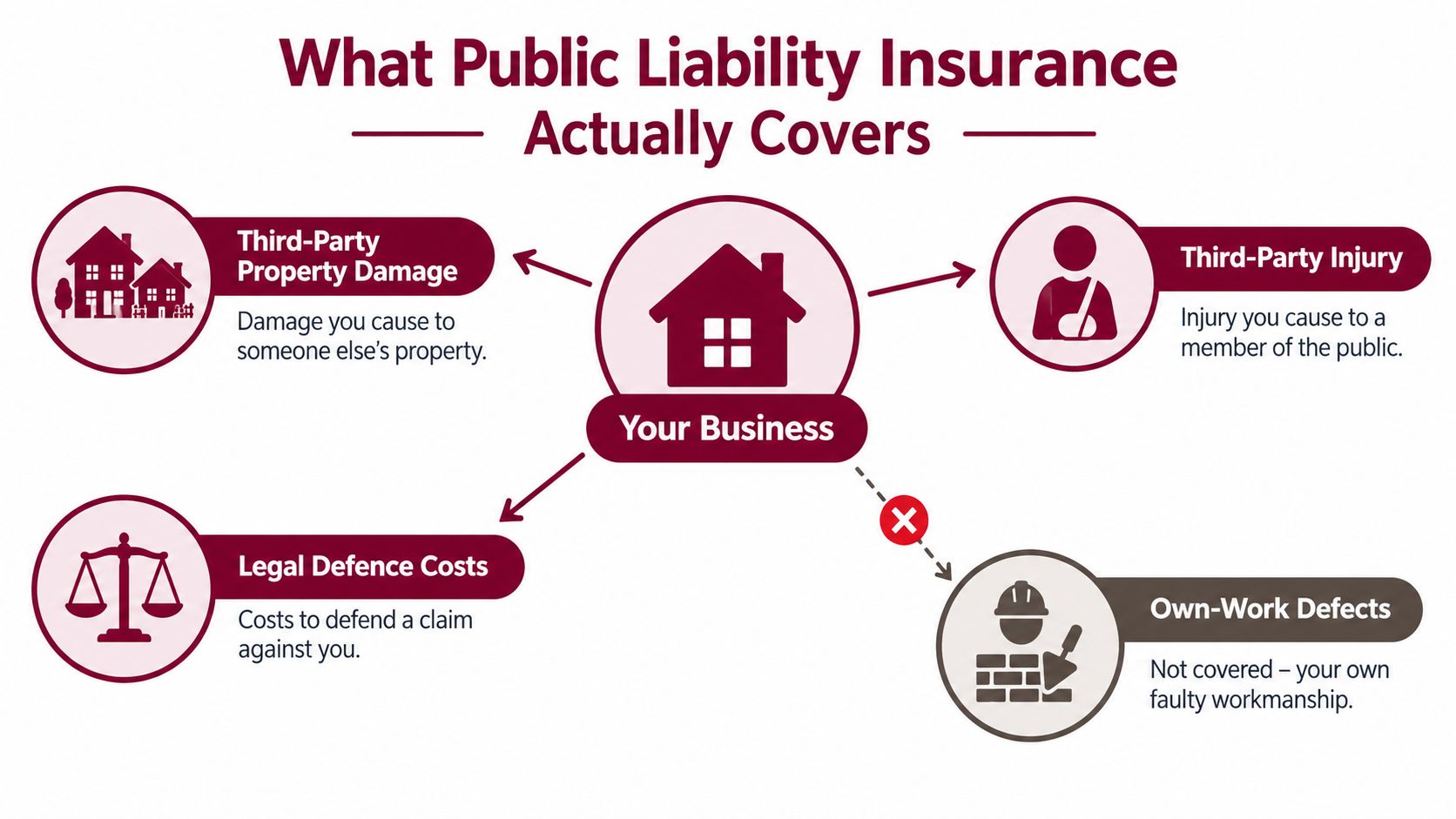
Think of your business as a house you're responsible for. Public liability isn't there to fix your own house when you build part of it badly. It's there when your work causes loss to someone else's house, someone else's body, or someone else's ability to use their property.
That's the core of public liability insurance coverage. If you're legally liable for third-party personal injury or third-party property damage arising from your business activities, the policy can pay compensation and, subject to its terms, legal defence costs. Negligence law shapes that promise, not the brochure language.
The three things it is built to do
First, it responds to injury you cause to a member of the public, a visitor, a neighbour, or another person who isn't your employee. A pedestrian trips over leads you've run across a footpath without protection. A client slips on a wet surface you left unsigned.
Second, it responds to damage you cause to property that doesn't belong to you. You crack an adjoining wall, flood a finished room, or strike underground services during excavation. The key word is other people's property.
Third, it can fund the defence of a claim made against you. Even a claim you ultimately win costs money to investigate and defend. Whether defence costs sit inside or outside your limit is a wording point you must check, because it changes how much protection you really have.
What it is not
Don't blur these covers together. They're separate for a reason.
- Contract works insurance: Covers material damage to the works under construction, such as fire, storm, or theft on site. It isn't a substitute for liability to third parties.
- Professional indemnity insurance: Responds to financial loss from negligent advice, design, or certification. If you design it, specify it, or sign it off, public liability alone may leave a gap.
- Workers compensation: Covers your employees for work-related injury under the statutory scheme. Public liability doesn't replace it.
- Plant and equipment insurance: Covers loss or damage to your own tools, plant, and machinery. Public liability doesn't pay to replace your stolen excavator.
One-minute test: If the loss is yours, look to your property, plant, or contract works cover. If the loss belongs to someone else and they blame you, that's when public liability enters the conversation.
Products liability often sits alongside public liability in the same policy. It deals with injury or damage caused by products you supply, install, or manufacture after you've handed them over. For builders and trades, that completed-work exposure matters long after you've left site.
Trigger Events, Claim Scenarios and the Own-Work Trap
Ask two questions of every incident. Is there a third-party loss, and does the wording treat your defective work itself as part of that loss? If you can't answer both, you don't know whether you've got a claim.
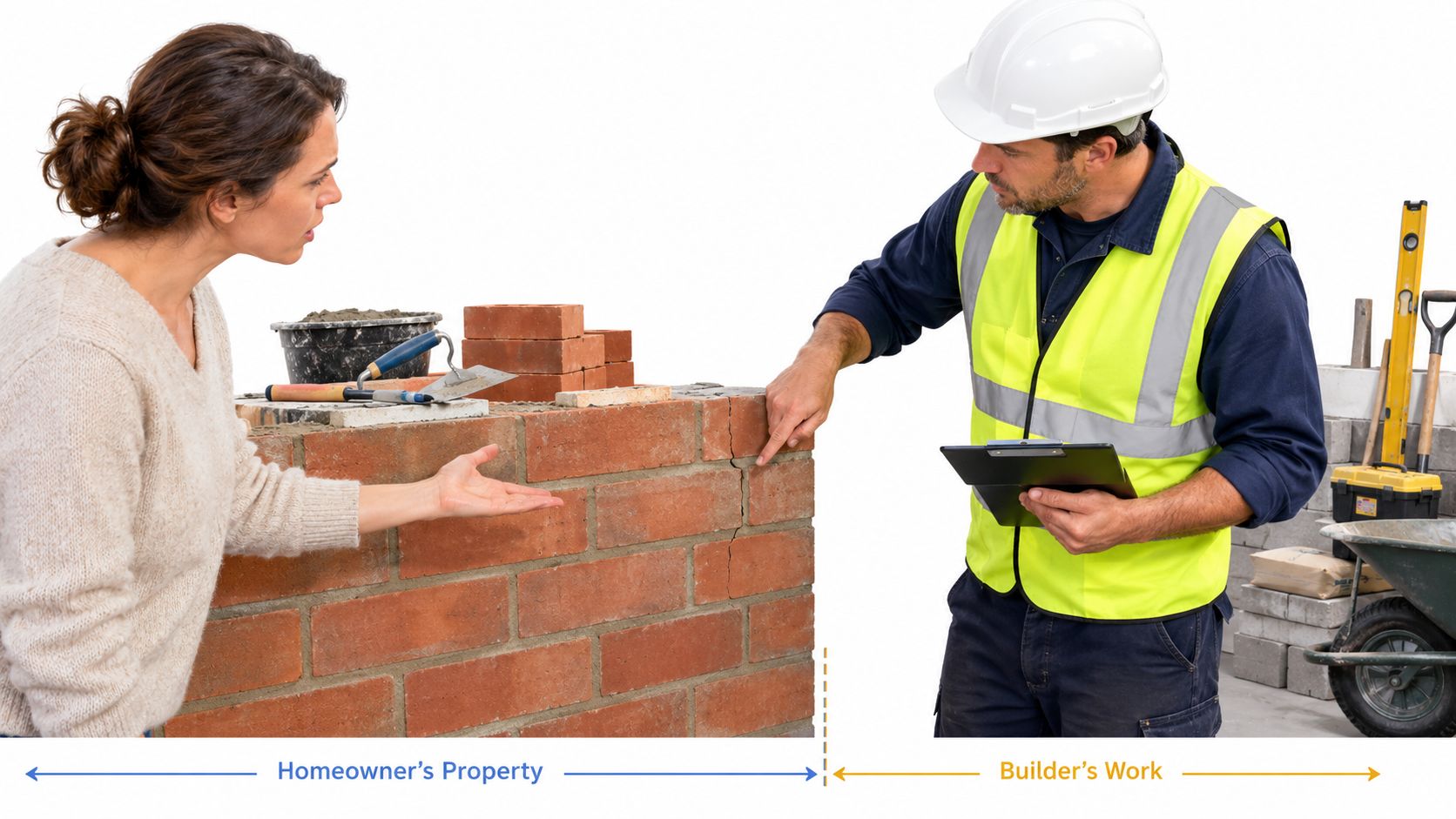
That second question is the own-work trap, and it's the biggest source of arguments between insureds and insurers in construction. A policy may pay for damage your faulty work causes to separate property while excluding the cost of removing and replacing the faulty work itself.
Three scenarios that show the line
A ladder strikes a neighbour's car. You lose control of a ladder and it dents a parked car next door. That's clear third-party property damage arising from your activity. Subject to excess and terms, this is the straightforward end of public liability.
A renovation damages an adjoining unit. You remove what you think is a non-structural wall and cracking appears in the unit next door. The neighbour claims for repair of their property and loss of use. Your liability for that resulting damage is the public liability question. The cost of engineering advice about your design decisions may pull professional indemnity into the frame.
A leaking installation ruins a ceiling. Your fitting fails and water destroys the finished ceiling below. The ceiling and contents damage is consequential third-party damage. Ripping out your fitting and reinstalling it properly is rectification of your own work. Many wordings exclude or limit that second cost.
That distinction also explains why products liability for Australian contractors after handover deserves separate attention. Once the job is complete and a supplied or installed product causes damage, you're in different wording territory from an accident during the work.
Exclusions that catch modern trades
Generic explanations hide the exclusions that matter on current sites. Public and products liability wording commonly excludes pollution clean-up costs, aircraft-related liability, and liabilities that must be insured locally overseas, as shown in the VMIA public and products liability policy wording.
Translate that to your work. You use a drone for roof inspections, and aircraft exclusions suddenly aren't theoretical. You excavate and disturb contaminated soil, and pollution wording matters. You accept a broad contractual indemnity from a principal, and you may have assumed liability your policy never agreed to cover.
Don't ask whether you're covered in general. Ask whether you're covered for this activity, this contract, and this type of loss. Anything less specific is guesswork dressed up as reassurance.
Limits, Excesses and Why a Bigger Number Is Not Always Safer
Most buyers fixate on whether the certificate says $5 million or $10 million. Those common limits mean little until you know if the limit applies per occurrence, in the aggregate for the policy year, or with sublimits for particular types of loss. You also need to know whether defence costs erode the limit.
An excess is the amount you contribute to a claim. A low premium with an excess you can't comfortably pay on a bad week isn't a saving. It's deferred pain. Some policies also impose different excesses for injury, property damage, or specific high-risk activities.
How one serious injury erodes protection
Construction severity isn't abstract. Safe Work Australia recorded 45 construction-worker fatalities in 2023, a fatality rate of 3.4 per 100,000 workers, and approximately 16,600 serious workers' compensation claims in construction, representing 12.0% of all such claims, with a median compensation payment of $18,500 and median time lost of 8.5 weeks, in the Safe Work Australia Key WHS Stats 2024 dataset.
Those are workers compensation figures, not public liability claims, so don't treat them as a direct estimate of third-party frequency. Use them as a severity warning. The same fall, dropped material, or plant movement that injures a worker can injure a visitor or neighbour, and then you're facing damages, legal costs, and investigation expenses under liability.
Size your limit against maximum credible loss, not the value of today's contract. A small job next to a busy footpath, a school, or expensive adjoining property can produce a claim that dwarfs your contract sum. Several incidents in one year can also eat into an aggregate limit, leaving you thinner than you thought for the next claim.
A higher limit doesn't fix a wrong activity description, a broken subcontractor arrangement, or an exclusion for the work you're actually performing.
Common contract requirements and where they bite
| Contract requirement | Policy wording that responds | Common pitfall |
|---|---|---|
| Minimum limit of indemnity | Limit per occurrence and in aggregate | Aggregate already eroded by earlier claims |
| Principal named as additional insured or interested party | Additional insured and cross-liability clauses | Principal noted for interest only, not actually indemnified |
| Waiver of subrogation | Subrogation waiver endorsement | You promise it in contract before insurer agrees |
| Contractual indemnity you assume | Contractual liability cover and exclusions | You accept liability beyond negligence and policy won't follow |
| Subcontractors to maintain own cover | Subcontractor conditions and vicarious liability wording | You never collect or check their certificates |
Read the contract clause and the wording side by side. If they don't line up, renegotiate the clause or fix the policy before work starts. After an incident, neither option is available.
Why Premiums and Availability Keep Moving
Builders often say claims are down, so premiums should fall. Australian data doesn't support that logic. Price follows severity as much as frequency, and public liability has been a regulatory story as much as an underwriting story for decades.
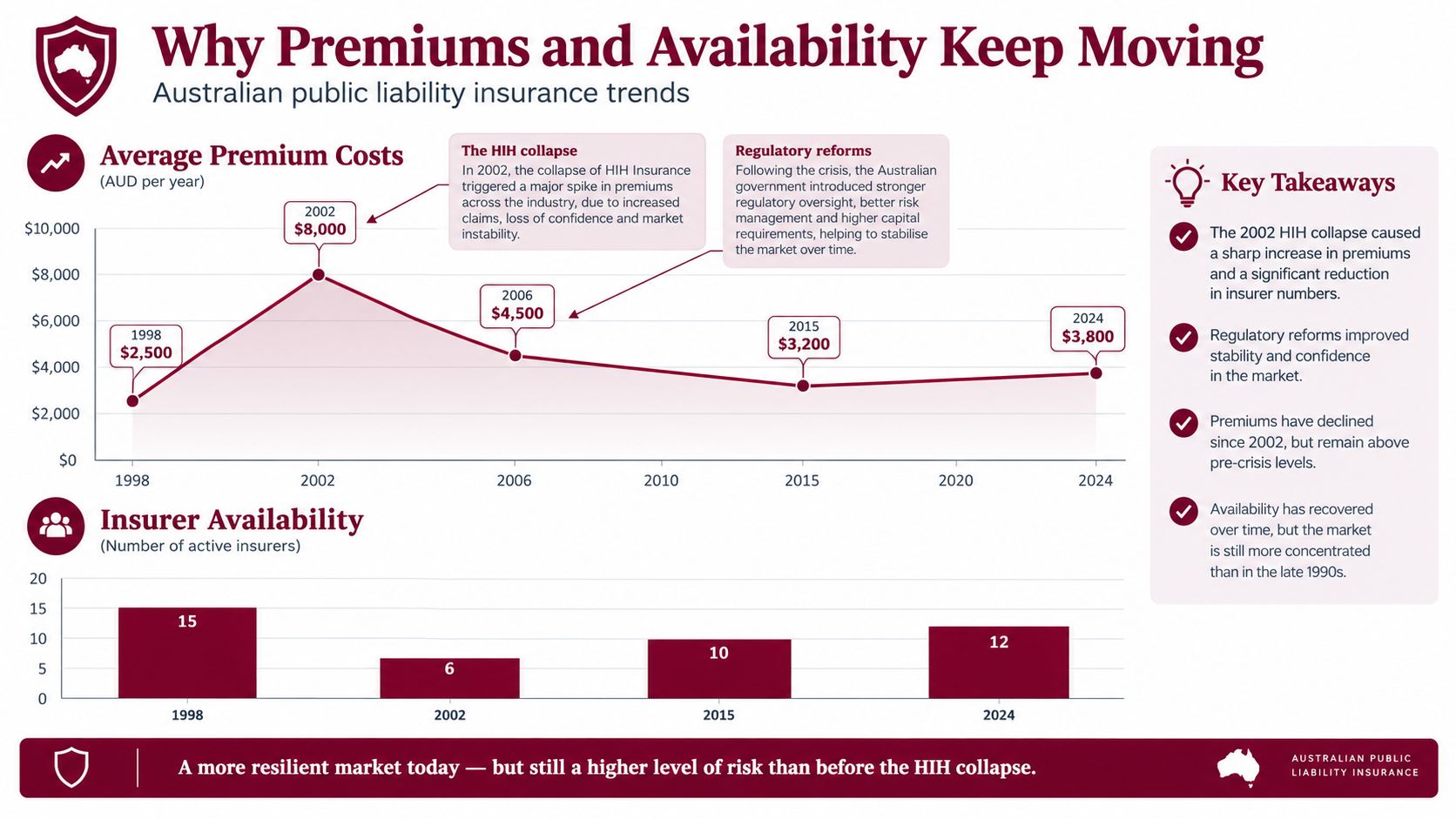
During the liability-cost crisis of the late 1990s and early 2000s, public and products liability claims rose from 55,000 in 1998 to 88,000 in 2000, a rise of approximately 60% in two years, average claim size doubled between 1996 and 2001, and the system recorded a shortfall of about $960 million, according to figures cited in APRA material on the historical liability crisis and subsequent reforms. Governments responded with tort and liability reforms, and average premiums later fell.
Fewer claims does not mean cheaper cover
More recent APRA analysis shows total premium volumes grew slowly from 2009 to 2016, averaging only 1.5% per year, but the average premium reached approximately $970 by 2021, which was 40% higher than in 2015 and equivalent to average annual growth of about 6% over 2015 to 2021, in APRA's National Claims and Policies Database statistics. APRA reported claim numbers reducing while average claim size rose approximately 5% per year from 2018 to 2021 and 7.5% annually over 2017 to 2021 in that same analysis.
That's the point to internalise. Fewer, larger claims can cost insurers more than many small ones. That pressure shows up in your premium, excess, sublimits, and exclusions, not just the headline price.
Industry evidence reports average public liability premiums rising by approximately 55 to 60% since 2019, tighter availability for high-risk construction operators, one in five businesses surveyed by Business NSW reporting being underinsured, and one in four experiencing premium increases above 30%, as reported in Insurance Business coverage of SME risk education and underinsurance. If you're comparing quotes, use the current Australian public liability pricing guide for 2026 as context, then compare wording, not just dollars.
For high-risk activities, availability itself is now part of the risk. If fewer insurers will quote your trade, you have less influence on price and terms. Start renewals early and give underwriters clean, documented risk information.
What to Check in the Wording Before You Sign
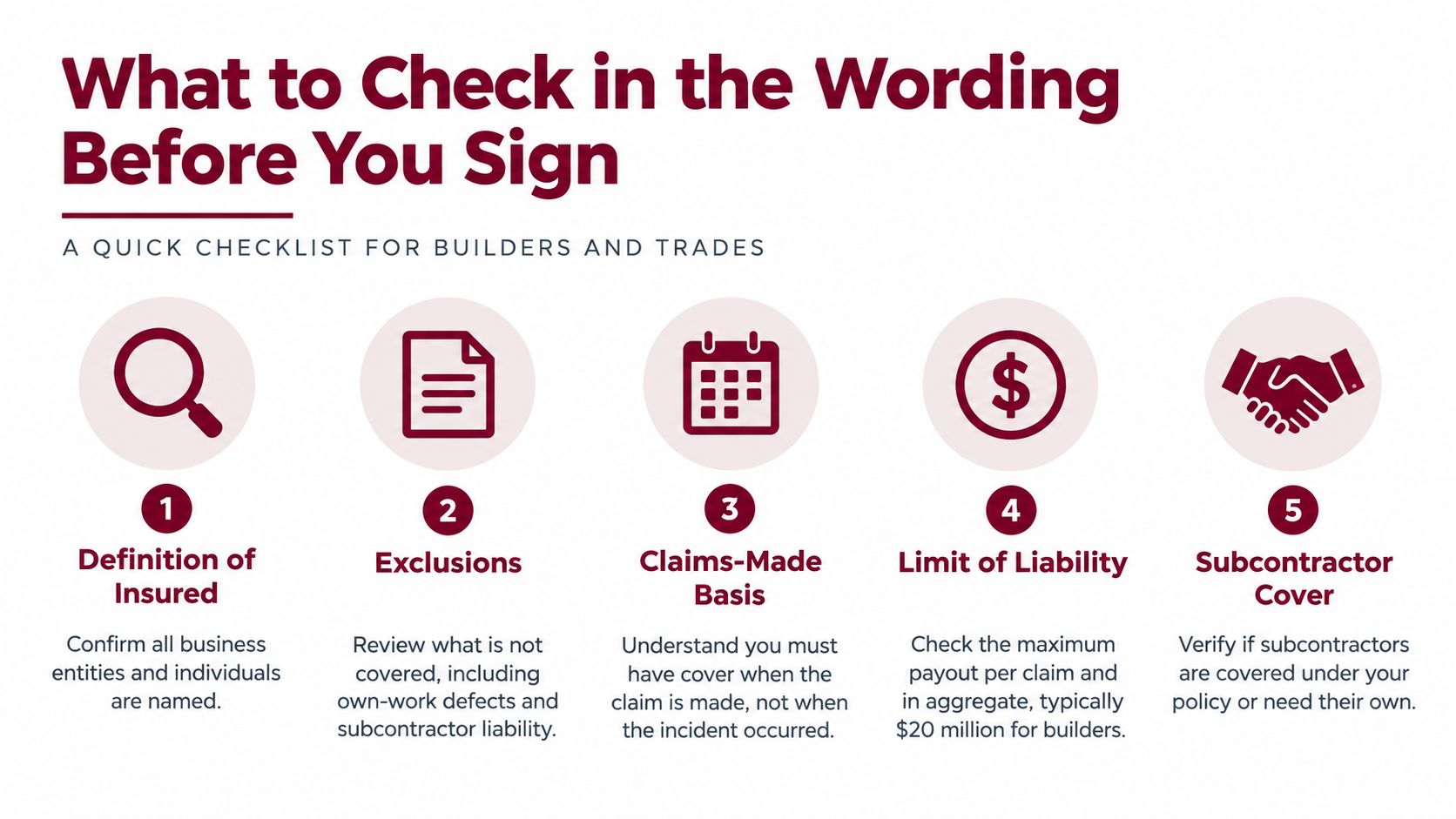
Don't ask your broker if you're covered. Put specific questions in writing and keep the answers. Verbal comfort won't help you in a dispute two years from now.
Each question below targets a gap that certificates hide. Work through them before you accept cover or sign a contract that names your insurance obligations.
Questions to put in writing
- Is the activity description accurate: Does it list every type of work you do, including height work, excavation, hot work, waterproofing, or work on occupied premises?
- Who is insured: Are all entities, directors, and trading names correct, and how are employees, labour hire, and subcontractors treated?
- Where are you covered: Does the geographic scope and jurisdiction match where you work and where contracts require you to be covered?
- What hazardous work is excluded: Check demolition, asbestos, pollution, underground services, cranes, and drones against your real job list.
- How do principal indemnities work: Does the policy support cross-liability and additional insured requirements without breaching contractual liability exclusions?
- What happens with plant: Is liability arising from owned or hired plant covered, excluded, or meant to sit under a separate plant or motor policy?
- When must you notify: What incident notification conditions apply, and who in your business is responsible for meeting them?
Registration and licensing sit alongside insurance, not inside it. Electricians, for example, should also understand their licensing obligations, and DLG Electrical on contractor registration is a useful starting point for that separate compliance question. Holding the right registration doesn't fix wrong wording, and holding insurance doesn't fix missing registration.
If the answer isn't in writing from your broker or insurer, treat it as unconfirmed.
One option for getting those answers tested against market wording is ABS Insurance Brokers Pty Ltd, which provides advice and placement for public liability and related construction covers for builders and trades. Whoever you use, judge them on whether they'll compare wording for your activities, not just requote last year's policy. That conversation is where the value is.
Matching Cover to Your Trade and Project
Match the policy to the exposure, not to what the bloke next door buys. Your trade, site access, contract terms, and use of subcontractors should drive the limit, excess, and supporting covers you ask about.
A sole-trader electrician working in occupied homes should focus on accurate activity description, products liability for installed items, and whether testing and certification work creates a professional indemnity need. A low excess may matter more than chasing the cheapest premium, because small property damage claims are plausible.
A practical way to frame the decision
A mid-sized residential builder needs public liability to sit cleanly with contract works, subcontractor controls, and principal requirements across multiple live sites. Aggregate erosion and cross-liability deserve attention, because one bad month can involve more than one site.
A commercial contractor should start with the contract. Minimum limits, additional insured wording, waivers of subrogation, and contractual indemnities will often dictate the structure. Don't sign insurance clauses you haven't had checked against the wording.
Specialist trades need specialist questions. If your work involves membranes and wet areas, you might browse Melbourne commercial waterproofing options to understand scope, but your insurance question is different. It's whether waterproofing is disclosed, whether resulting water damage is covered, and how rectification of failed work is treated. Scope documents and insurance wording must describe the same job.
For owner-builders and small retail or hospitality operators, public access changes everything. Customers, deliveries, and visitors moving through your premises create injury exposure even when no construction is occurring. Your limit should reflect foot traffic and adjoining property, not just turnover.
Do three things next. First, pull your current schedule and wording, not just the certificate. Second, write down the work you did in the last year and compare it line by line with the activity description and exclusions. Third, take your next contract's insurance clauses to your broker before you sign, and get the answers in writing. That's how you turn public liability from a compliance cost into protection you can rely on.
ABS Insurance Brokers Pty Ltd helps builders, trades, developers, and small businesses compare public liability wording against their actual activities, contracts, and subcontractor arrangements, and place cover alongside contract works, professional indemnity, plant, and business insurance where needed. If your certificate is coming up for renewal or a principal is pressing you to sign, get the wording checked first by visiting ABS Insurance Brokers Pty Ltd and asking for a policy review before you commit.