

Over 90% of NSW businesses reported higher general insurance costs over the previous 12 months. Most saw increases of 11% to 30%, and about one in four were hit with rises above 30%.
That's the reality behind every renewal letter landing on a builder's desk right now. If you're a tradie, contractor, or small business owner, business insurance costs aren't drifting up a little, they've become a hard operating problem that needs proper management.
Table of Contents
- Why Business Insurance Costs Are Rising Across Australia
- The Six Primary Drivers of Your Insurance Premium
- Construction Industry Costs Compared to Other Sectors
- How NSW Taxes and Levies Inflate Your Premium Bill
- The Real Cost of Multi-Policy Insurance for Builders and Trades
- How Brokers Use Market Access to Reduce Your Premium
- Actionable Strategies to Manage Premiums and Excesses
Why Business Insurance Costs Are Rising Across Australia
A builder gets the renewal notice, scans the number, and feels the same frustration every other NSW operator feels. The problem isn't just the premium itself, it's that insurance costs have become a recurring pressure point, not a one-off shock. NSW business surveys show insurance costs stayed the most significant cost concern across all four quarters of 2024, which tells you this is structural, not temporary.

A tradie doesn't need a lecture on macroeconomics. They need to know why a policy that looked manageable last year now feels out of reach, and what part of the bill is negotiable. In many cases, the answer is that the insurer is pricing a higher-risk book, a tougher claims environment, and a market where affordability has become a live issue.
The first mistake is treating premium growth as random
When business owners see a jump at renewal, they often assume the insurer is being difficult. Sometimes the quote reflects the actual risk profile, but sometimes it reflects a market that has shifted broadly and kept shifting. The NSW evidence is blunt, over 90% of businesses saw costs rise, and the majority saw those increases land in the 11% to 30% band, with about one in four facing more than 30%.
That's why waiting and hoping for a softer renewal usually wastes money. If your business relies on property, liability, or interruption cover, you need to understand what's driving the price before you decide whether to accept it, challenge it, or restructure it. A broker who reads the market properly can help with that, but only if the business owner brings clean information and a willingness to review the whole program.
Why this matters to the bottom line
Insurance is no longer a background admin task. It's part of your operating margin, and if you ignore it, the premium increase comes straight out of cash flow, pricing power, or wages. That's the core issue with rising business insurance costs: they don't just hurt once a year, they affect every job you quote after renewal.
If you're in construction, trades, or a project-based business, this matters even more because risk changes from job to job. A static annual mindset doesn't fit a business that carries tools, labour, subcontractors, vehicles, and contract obligations across multiple sites. The premium follows the exposure, and if the exposure changes, the cover needs to change too.
The Six Primary Drivers of Your Insurance Premium
Insurers don't pull a number out of thin air. They price the combination of what you do, how you do it, where you do it, and how much damage a claim could cause. If you want a quote that makes sense, you need to look at the same levers the insurer is looking at.
Cover type and claim severity
A public liability policy is not priced like cyber insurance, because the loss patterns are different. Recent Australian quote data puts public liability around $42-$46 per month and cyber insurance around $130 per month, which is a good reminder that insurers price by claim frequency and severity, not by policy count alone. You can't compare policies fairly if you ignore what each one is designed to absorb. commercial truck insurance forecast for fleets is a useful example of how different vehicle-heavy risks get treated differently in the market.
Industry hazard level, turnover, and headcount
A retail shop and a roofing contractor won't get the same treatment. Industry hazard level, turnover, and employee or subcontractor count all push the premium because they change the size and complexity of the loss. More people on site, more moving parts, more opportunity for a claim. If you want a practical comparison point for exposure-based pricing, see the benchmarks in this guide on professional indemnity costs, which helps show how pricing shifts by profession and risk profile.
Practical rule: if the quote looks high, ask which exposure is driving it. Don't accept a black-box price when the insurer is clearly reacting to a specific risk factor.
Assets, stock, excess, and location
The value of your tools, materials, stock, and equipment matters. So does the excess you choose, because a lower excess usually means a higher premium, while a higher excess can trim cost if you can handle the out-of-pocket risk. Location also matters. Flood and bushfire exposure can move a quote fast, especially where the insurer sees a high likelihood of a severe event. For a fleet-heavy business, this kind of location and usage sensitivity is exactly why commercial truck insurance forecast for fleets is worth reading alongside your broker's recommendation.
Construction Industry Costs Compared to Other Sectors
A generic average is useful only until you need to insure a real construction business. The average business insurance package sits around $89 per month, but that figure blurs the difference between a low-risk office operation and a builder carrying contract works, public liability, plant, vehicles, and project-specific liability. Retail averages $103 per month and food businesses about $145 per month, which already shows how industry mix shifts the bill.
NSW HBCF premium rates by construction type
| Construction Type | Rate Excluding GST & Duty | Rate Including GST & Duty | Minimum Premium |
|---|---|---|---|
| H01 new dwelling construction | 0.709% | 0.850% | $200 |
| H02 existing apartment-building work | 3.293% | 3.948% | $200 |
| H03 new apartment construction | 5.684% | 6.815% | $200 |
The spread is the point. New apartment construction is priced far above new dwelling work because the risk profile is heavier, the claims severity is greater, and the insurer is taking on a different level of exposure. HBCF premiums are explicitly linked to the contract price or the reasonable market cost of labour and materials, which means the work value, not just revenue, drives the charge. For licensed builders, engraving for grant compliance is the kind of admin detail that can matter when documents and contract records need to line up cleanly.
Why construction averages mislead
Construction professional indemnity pricing shows the same pattern. One Australian guide puts professional indemnity for construction and trades at a typical $2,119 a year, compared with $515 for financial, legal, and professional services. That's not a small gap, it's a warning that you can't use an office-business benchmark to judge a builder's program. Builders and subcontractors often need several covers at once, and each one adds cost because each one answers a different exposure.
A builder quoting from a single-policy average is underestimating the real bill. The program, not the headline policy, is what matters.
How NSW Taxes and Levies Inflate Your Premium Bill
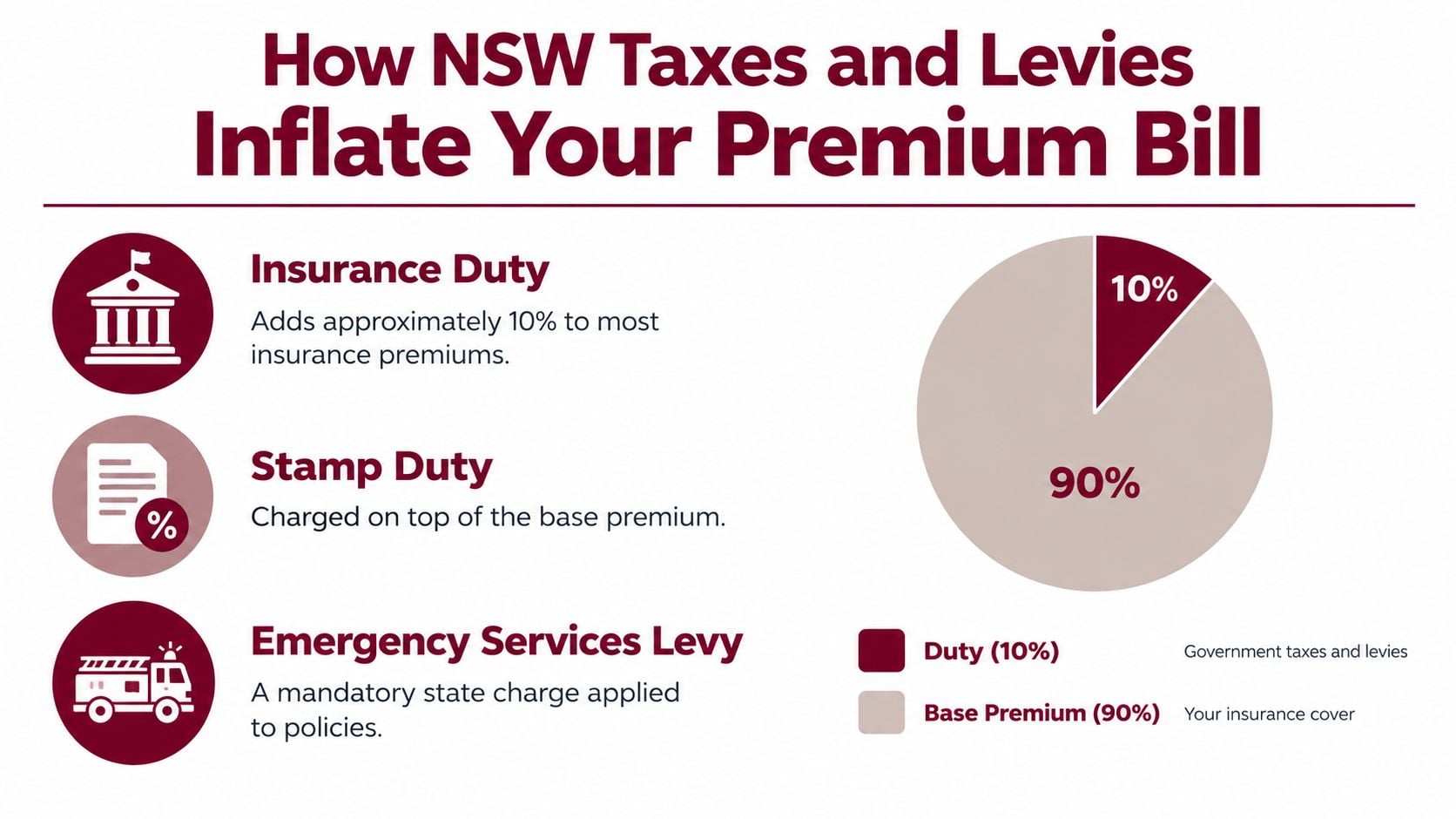
A lot of owners argue about insurer margin and ignore the charges sitting on top of the premium. That's a mistake. In NSW, insurance duties add around 10% to most insurance types, the Emergency Services Levy adds an estimated 30% to 35% to commercial premiums, and in one insurance inquiry report the combined emergency services levy, GST, and stamp duty was described as reaching up to 70% of the premium cost. That's not small change, it's a major part of what you pay. Home Building Compensation Fund NSW what licensed builders must know in 2026 is a useful companion read for builders who need to see how compulsory cover and state charges interact.
Don't confuse tax burden with underwriting cost
This distinction matters because it changes how you negotiate. You can push back on avoidable cover, excesses, limits, and policy structure, but you can't negotiate away government charges. If you don't separate the two, you end up chasing the wrong savings and blaming the wrong part of the premium.
The broader market backdrop matters too. APRA-related submissions showed total intermediated premium invoiced reached $22.97 billion for the six months to December 2025, up from $21.59 billion in the June 2025 half year and $22.28 billion in the same period a year earlier. That tells you pricing pressure has been broad, not isolated. Rising premium volume at market level usually filters down to the renewal desk sooner or later.
What to ask your broker
Ask for the premium split. Ask for the insurer charge, the duty, the levy, and the GST line if they're shown separately. Once you can see what's controllable and what isn't, you can budget properly and make cleaner decisions about whether to restructure cover or shop the placement harder. Engraving for grant compliance may sound unrelated, but for builders, accurate documentation often underpins the cover conversation too.
The Real Cost of Multi-Policy Insurance for Builders and Trades
Single-policy averages are comforting and misleading. A builder might see a public liability quote around $605 a year and think the program is manageable, then discover the actual cost comes from stacking public liability, contract works, plant and machinery, commercial motor, cyber, management liability, and HBCF-related cover across multiple entities or project structures. That's where the budget gets squeezed.
Why bundled risk costs more
Construction and trades sit in a higher-risk pricing class than low-risk office businesses. One Australian guide pegs professional indemnity for construction and trades at $2,119 a year, compared with $515 for financial, legal, and professional services. That gap tells you the sector itself is expensive to insure before you even add the project-specific layers. venue liability insurance rules is a useful reference point for understanding how liability expectations can shift once a business starts taking on public-facing or contract-driven risk.
The problem with line-by-line shopping
A lot of owners ask for separate quotes and compare them as if the sum will somehow be efficient. It usually isn't. A broker looking at the full program can spot overlaps, gaps, and cover that doesn't earn its keep. Standalone quotes can also hide the fact that one cheaper policy forces a higher excess or narrows the wording enough to make the saving false.
What the real cost lens should be
Think in terms of the total insurance burden, not the cheapest single line item. If a policy looks cheap but the business still needs three other covers to operate safely, the headline figure is useless. The right question is simple, what does the full program cost, what does it exclude, and what exposure is still left sitting with the business?
For builders and trades, that question matters every year because jobs change, sites change, and subcontractor structures change. A quote built on last year's assumptions is often already stale by the time renewal lands.
How Brokers Use Market Access to Reduce Your Premium
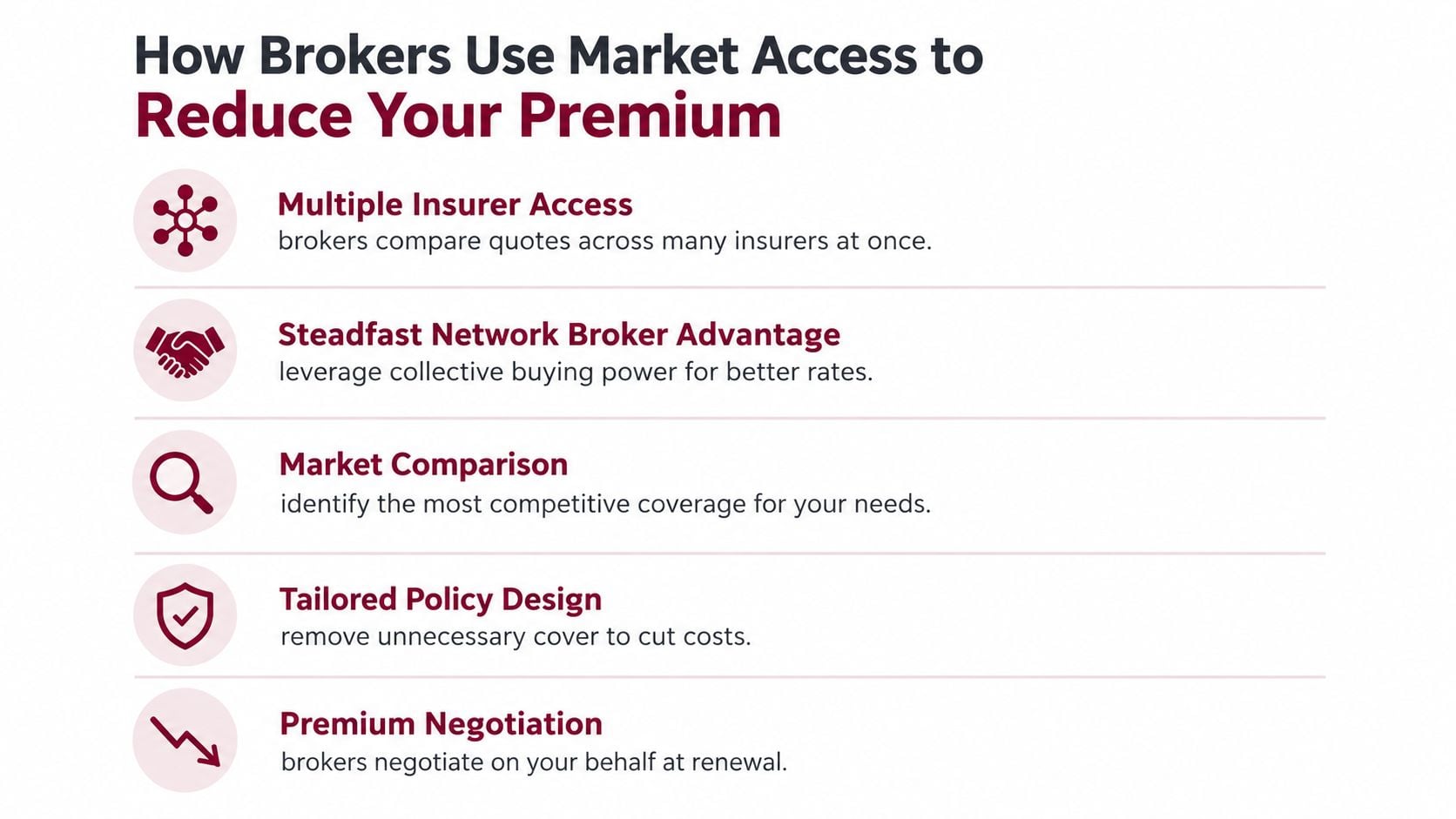
A good broker doesn't just send your details to one insurer and forward the reply. They compare placements, push for terms that fit the actual risk, and cut out cover that doesn't earn its place. That matters more in a hard market, where insurance costs have stayed the top concern across multiple quarters and owners need someone who can read the market, not just relay it.
Market access changes the result
Brokers with broad placement capability can test the market more effectively than a direct renewal. That doesn't guarantee a lower premium, but it gives you a real comparison rather than a single take-it-or-leave-it number. In practice, that can mean better wording, a more sensible excess, or a different insurer appetite that matches the project mix better.
Where broker value is real
A broker earns their keep when they do the unglamorous work. They structure the policy around actual activity, not generic labels. They challenge assumptions that inflate the risk rating. They also know when a premium looks high because the business has changed, and when it looks high because the insurer is not the right fit.
For businesses comparing fee models, insurance broker fee vs commission is worth reading because the payment structure should never be confused with the value of the placement work. ABS Insurance Brokers Pty Ltd is one option in the market for builders, trades, and commercial clients who need advice and placement across business and construction-related covers.
Rule of thumb: a broker should reduce friction, tighten the wording, and test the market. If they only hand you a quote, you're paying for admin, not expertise.
Actionable Strategies to Manage Premiums and Excesses
Start with the excess. If your business can comfortably absorb a larger out-of-pocket amount on a claim, a higher excess can reduce the premium. If cash flow is tight, don't chase a short-term saving that becomes painful the moment something goes wrong.
Build your renewal file early
- Document risk controls: list site security, induction processes, tool storage, cybersecurity measures, and safety procedures, because underwriters price discipline.
- Prepare loss runs and project schedules: give the broker a clean picture of claims history and current jobs so they can argue from facts, not guesswork.
- Review cover overlaps: remove duplicated policies or unused extensions that add cost without adding useful protection.
- Test excess levels deliberately: compare the premium saving against the amount you could pay after a claim.
- Time the review properly: don't leave negotiation until the last week before renewal, because that's when you lose influence.
Ask harder questions at renewal
Ask whether the insurer is pricing last year's profile or this year's reality. Ask whether the cover still matches the project type, subcontractor mix, and asset base. Ask what happens to the premium if you adjust the excess, narrow one extension, or restructure the placement across multiple policies.
Practical rule: insurance is a risk transfer tool, not a box to minimise blindly. If you only chase the cheapest number, you'll usually pay later in gaps, exclusions, or claims frustration.
Premium reduction is a process, not a one-off victory. The businesses that keep costs under control review their program every renewal, keep their paperwork tight, and use a broker who can place the risk properly instead of just quoting it.
If you want a sharper view of what your current cover is really costing, speak with ABS Insurance Brokers Pty Ltd. They place business and construction-related insurance for builders, trades, and commercial clients, and they can review whether your premium, excess, and cover structure match the work you're doing.